In my years as a Project Manager, I have seen a lot of industries try to digitize. But retail? Retail is different. It is high velocity, high churn, and, honestly, it is often high stress.
When we talk about the retail floor, we are not talking about people sitting at desks with dual monitors and stable 9 to 5 schedules. We are talking about the deskless workforce, the people who are the face of your brand. Yet, for decades, we have asked these dynamic teams to manage their professional lives through archaic Excel sheets, frantic WhatsApp groups, and paper based onboarding.
It is time we admit that traditional HRMS tools have failed the retail sector. They were built for offices, not for the floor. That is why we are seeing a massive shift toward Store Operations on Autopilot.
The Reality of the Retail Floor
To understand why autopilot is necessary, we have to look at the data. I have been diving into workforce analysis reports, like the HB 2019 Retail Industry Workforce Analysis (2022 Preliminary Report) found at the Workforce Training & Education Coordinating Board, and the trends are clear. Retail remains a primary economic engine, but the complexity of managing it has skyrocketed.
We are seeing a move toward hybrid shopping, where the lines between a physical store, a warehouse, and a customer service hub are blurring. This means the person working the counter today might be managing a Click and Collect surge tomorrow. If your management system is static, your team is already behind.
From Interface Debt to Chat First Design
One of the biggest hurdles I see in project execution is what I call Interface Debt. If you have to give an employee a 50 page manual to show them how to request a shift change, your software is broken.
In retail, adoption is everything. If the tech is too hard to use, staff just will not use it. This is why I am such a firm believer in a chat first philosophy. We spend our personal lives on WhatsApp and Slack; why should work feel like a trip back to 1998? By moving the UI into a conversational interface, we have seen adoption rates jump from 20% to over 90%.
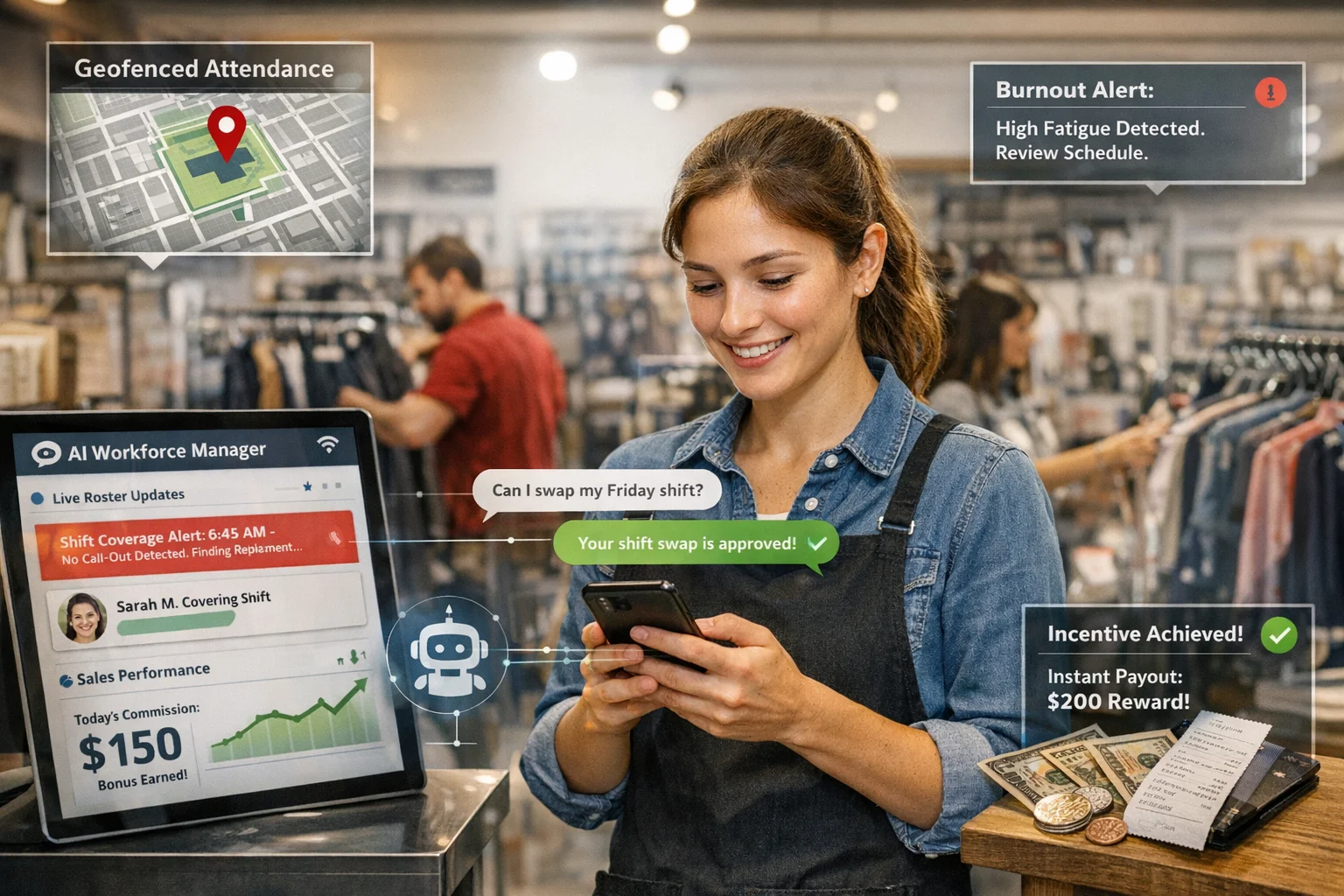
When an employee can simply type, What is my commission for this week? or Can I swap my Friday shift? and get an instant, AI driven response, the friction disappears.
Enter Agentic HR Workflows: The Invisible Manager
This is where it gets exciting for me as a PM. We are moving beyond simple automation, where if X happens, do Y, and into the era of Agentic HR Workflows.
Think of an AI agent as a digital coordinator that does not just store data but reasons with it.
The Late Night Sentry: Instead of a manager waking up to five I am sick texts, an AI agent can detect the absenteeism, look at the regional roster, identify a nearby staff member with the right skills who is not hitting overtime, and send a nudge to fill the gap, all before the sun comes up.
The Burnout Detector: By tracking Digital Exhaust (patterns like consecutive weekend shifts or late night logins), the system can warn a manager about potential burnout before a high performing employee hands in their notice.
In a high churn industry, these micro interventions are the difference between a smooth running flagship and a store that is understaffed during a holiday rush.
Solving the Buddy Punching Problem with Integrity
Let us talk about the elephant in the room: attendance integrity. In multi outlet chains, buddy punching, where one employee clocks in for another, is a silent profit killer.
But nobody wants to feel like they are being policed by Big Brother. The solution I advocate for is Geofenced Attendance. It is simple, transparent, and mobile native. You can only clock in if your GPS coordinates match the store footprint. It removes the integrity gap without requiring expensive hardware or intrusive biometrics. It just works.
Real Time Incentives: The Ultimate Motivator
In retail, your frontline is your sales force. Yet, most commission structures are black boxes. An employee makes a big sale in June, and they do not see the reward until the end of July. That delay kills motivation.
We have seen that linking sales targets directly to payroll via APIs changes the energy on the floor. When a staff member can see their Incentive Milestone met in real time on their phone, they are not just working a shift, they are driving a business. We have seen this reduce incentive calculation time from days of manual data entry to an instant, transparent payout.
The Zero Training Goal
My goal for every project I lead is Zero Training Adoption.
The retail workforce is often seasonal. If it takes you three days to onboard a temporary hire for a two week festive surge, you have lost the ROI on that hire. By using Lite Onboarding (where a worker uploads their ID and signs their contract via a smartphone), we get people floor ready in minutes.
We have seen scheduling time drop from 4 hours of Excel misery to 15 minutes of AI assisted rostering. That is 3 hours and 45 minutes that a Store Manager gets back to spend with customers and coaching their team.
Software Should Speak Human
At the end of the day, retail is not about SKU numbers or floor layouts; it is about people.
We have spent decades training humans to speak software, forcing them to click through endless menus and fill out redundant forms. I believe we are finally at a point where software can finally speak human.
Whether it is using Natural Language Processing (NLP) to answer a leave policy question or using vector embeddings to find a specific training video without knowing the filename, the tech is finally catching up to the needs of the frontline.
The move to Autopilot in the retail sector is not about replacing managers. It is about clearing the administrative clutter so those managers can actually lead. Because in the high velocity world of retail, the only way to stay ahead is to stop looking at the paperwork and start looking at the people.