I remember the first time I sat down with a founder in Riyadh who was trying to manage a growing team of 60 people using nothing but a complex web of Excel sheets. He looked at me and said, "I feel like I'm running a data entry firm, not a tech company." By 2026, that feeling has only intensified for those stuck in the past.
The Saudi labor market has completely changed. With Vision 2030 in full effect, the era of paperwork is over. If you’re doing business in the Kingdom today, whether you’re a fast-growing startup in Jeddah or a large manufacturing plant in Jubail, your HRMS is not just a place to keep names. It acts as your compliance protector and drives your growth.
After years of advising companies on scaling their people operations, I have identified the 10 "non-negotiable" features that every HR platform in Saudi Arabia must have in 2026.
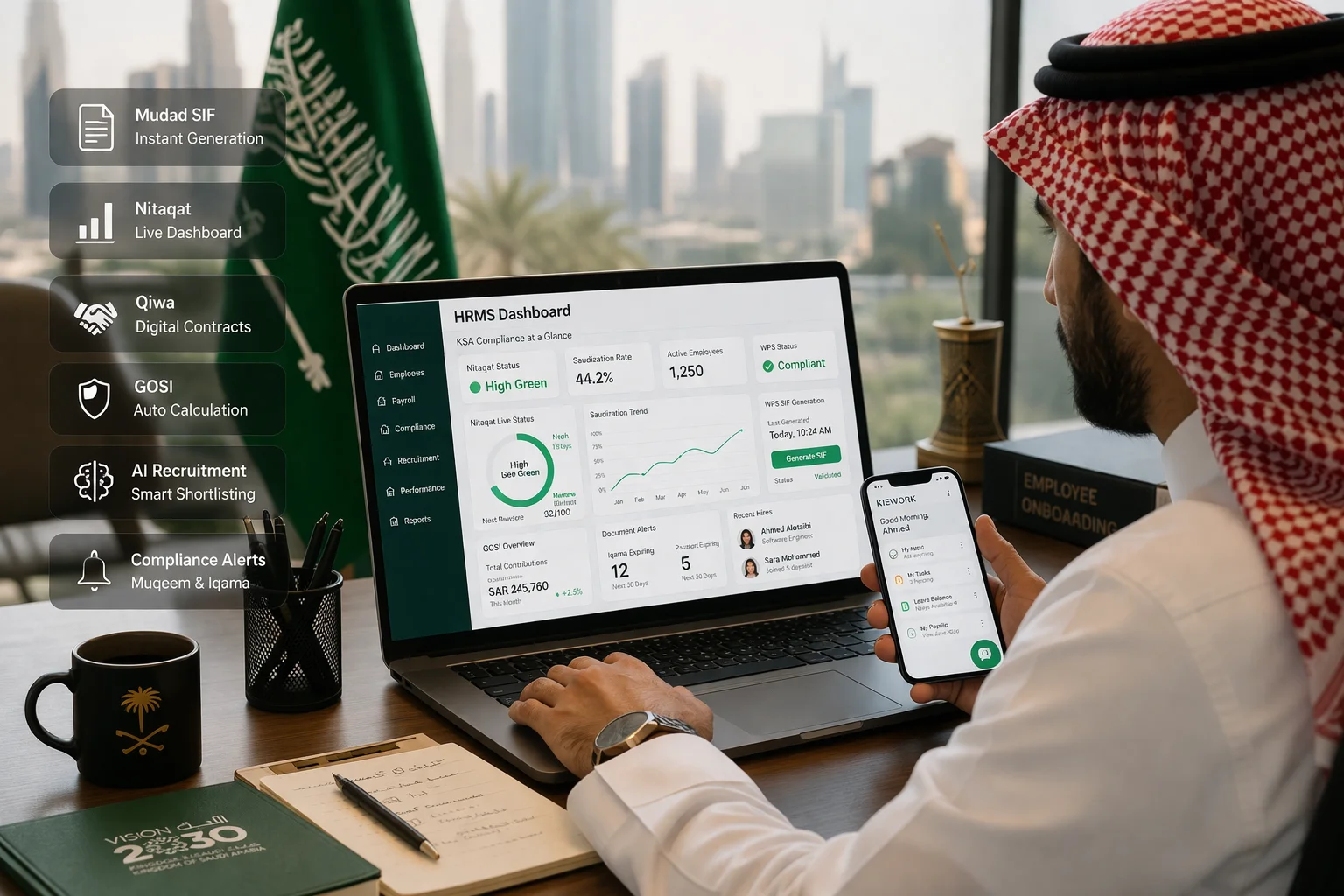
1. Instant Mudad & WPS SIF Generation
In 2026, the Wage Protection System (WPS) is not just a suggestion; it is a real-time monitor linked directly to your corporate financial health. I always tell my clients: if your HR software cannot generate a validated SIF (Salary Information File) for the Mudad portal in under two minutes, it is costing you money. Manual SIF preparation used to take four hours; today, that is an operational leakage you simply cannot afford.
2. Live Nitaqat & Saudization Dashboards
Compliance in Saudi Arabia is a moving target. The Nitaqat program now uses sophisticated "Mutawar" logic that focuses on both the quantity and quality of employment. I prefer systems that give me a "Live Quota Dashboard." You should know, at any given second, if a new hire will push you from "High Green" to "Platinum" or, heaven forbid, down to "Red." This is especially critical for the retail sector in Dammam, where high turnover can shift your status overnight.
3. Native Qiwa Integration & Digital Contracts
Gone are the days of physical filing cabinets for labor contracts. In 2026, all contracts must be migrated to the Qiwa platform to be legally valid. I am looking for an HRMS that offers a "Digital Contract Sync." When a new hire signs their offer on the candidate portal, that data should flow directly into Qiwa without a single manual keystroke.
4. Precision GOSI Deductions
Social insurance is a major line item on any Saudi balance sheet. Whether it is the 22% contribution for your Saudi nationals or the 2% occupational hazard risk for your expat workforce, the math must be 100% precise. I have seen companies face massive audit risks because their "global" HR software did not understand the nuances of GOSI. A localized engine that auto-updates as GOSI regulations evolve is a must-have.
5. Specialized KSA End-of-Service (EOS) Logic
The Saudi Labor Law outlines specific rules for gratuity. The calculation depends on whether the employer or the employee ended the contract, as well as the length of service. Your HRMS should manage this logic on its own. When an employee leaves your company in Al Khobar, the system should quickly and accurately calculate the "End of Service Benefits" (EOSB) to ensure a compliant and smooth exit.
6. Mobile-First "Chat-First" Interface
We have one of the youngest, most tech-savvy workforces in the world. Modern employees do not want to log into a clunky web portal to see their payslips. I advocate for a chat-based or mobile-native UI. Whether it is requesting leave while at a café in Riyadh or checking an Iqama expiry date on the go, the HR experience should be as easy as sending a WhatsApp message.
7. AI-Powered Recruitment & Shortlisting
For startups in the Kingdom, speed is the only currency. Top talent in the Saudi market is often off the table in 10 days. I suggest using a platform with an "Interview Kanban" and AI shortlisting. This allows founders to reduce their time-to-hire by up to 60%, ensuring they snag the best engineers or sales leaders before the competition does.
8. Muqeem & Iqama Renewal Alerts
For sectors like manufacturing and healthcare that rely on a diverse mix of local and expat talent, document tracking is a full-time job. I look for "Proactive Compliance Alerts." Your system should ping you weeks before an Iqama or passport expires, preventing the heavy fines that come with oversight.
9. Hybrid Culture & Engagement Tools
With many Saudi companies adopting hybrid work models, building a culture of accountability is harder than ever. I love features like "Peer Recognition" and "Mood Tracking." These are not just "nice-to-haves." They are the tools that help you build a culture of performance where employees take ownership of their results.
10. Automated Onboarding "Wizards"
In the healthcare industry, where you might be onboarding 20 nurses and doctors at once, a "frictionless onboarding" process is vital. I prefer a "Wizard" style interface that guides a non-HR manager through the process: from asset tracking (laptops, uniforms) to digital document collection, ensuring the new hire is "Day One" ready.
Why This Matters for Your Business When I talk about HR automation, I am not just talking about convenience. I am talking about Capital Efficiency. Every hour your team spends manually checking Nitaqat levels or fixing a GOSI error is an hour not spent on strategy or growth. I call this the "Manual Tax." By moving to a localized, AI-powered system, you are not just following the law; you are optimizing your EBITDA.
If you are ready to move away from the limitations of old systems and adopt a quicker, more flexible approach to managing your people, it is time to explore how modern technology can help.
Creating a culture of performance begins with having the right data readily available. If you want to understand how automation affects your profits, you can discover the best HRMS software in Saudi Arabia to see how digital transformation delivers real returns on investment for your organization.