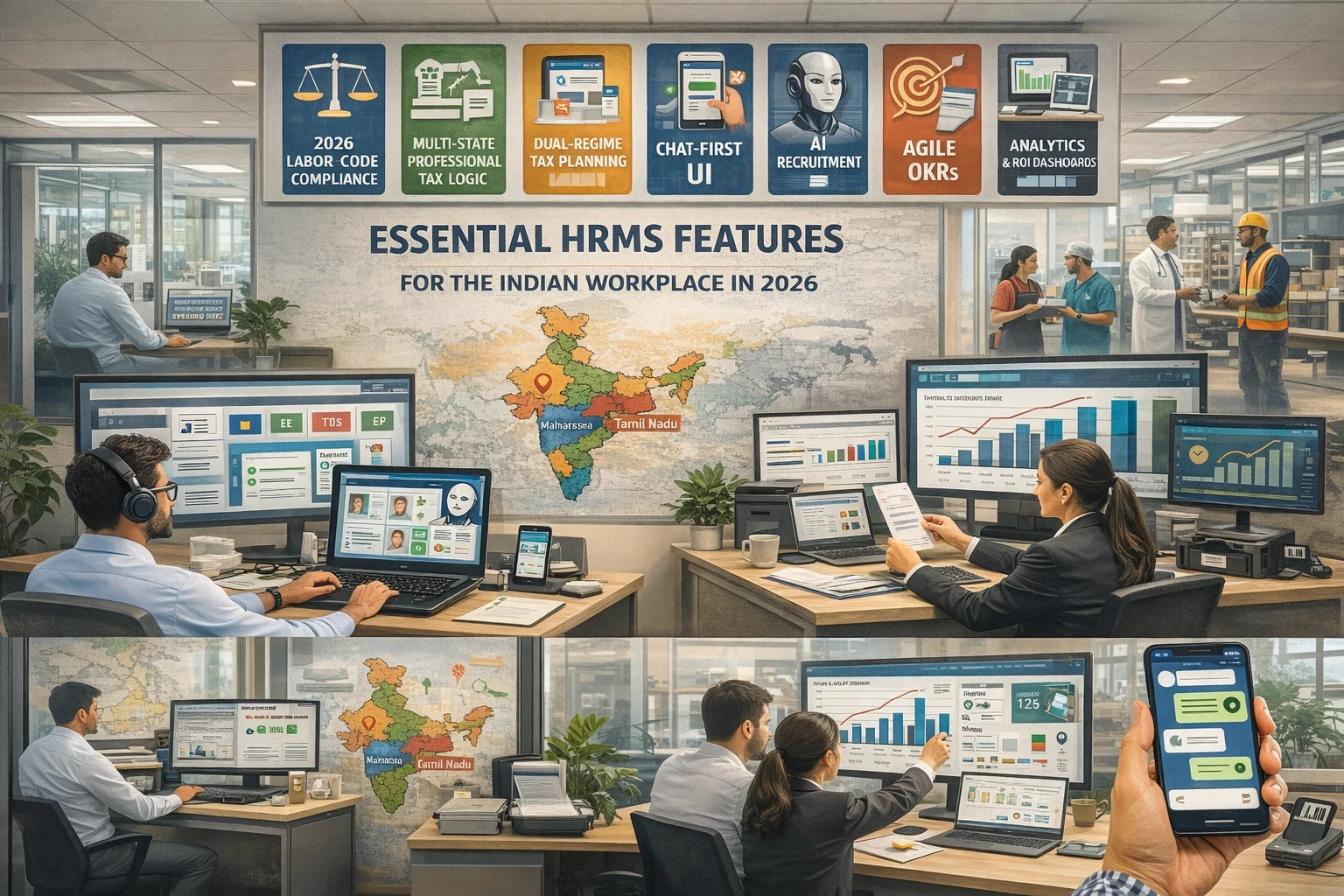
The Indian workplace is undergoing a seismic shift. As we navigate through 2026, the complexity of managing a workforce isn't just about hiring and firing anymore. It is about navigating a dense web of new labor codes, hybrid work cultures, and an increasingly digital-first employee base.
I have dedicated a significant amount of my time researching the role of technology in linking the pain points of administration with real culture development. As a company based in India, be it a high-growth startup in Bangalore, a manufacturing company in Gujarat, a health care organization in Kerala, or a retail store chain across India; your HR technology must serve beyond document management.
Here are the top 10 features I believe are non-negotiable for an HRMS in India this year.
1. Automated 2026 Labor Code Compliance
The Statutory Maze in India is real. With the full rollout of the four new Labor Codes, the biggest challenge I see founders facing is the 50% Wage Rule. You need a system that automatically calculates the impact on your Cost to Company (CTC) and ensures that basic pay remains at least 50% of the total remuneration. If your software isn't auto-adjusting for these mandates, you’re sitting with a compliance headache.
2. Hyper-Local Statutory Engines (PF, ESI, TDS)
India isn't a monolith; it is a collection of states with varying rules. I always look for a platform that handles Provident Fund (PF), Employee State Insurance (ESI), and Tax Deducted at Source (TDS) with zero manual intervention. In 2026, automated should mean one-click Electronic Challan cum Return (ECR) generation. You shouldn't be spending three days on filings; it should take fifteen minutes.
3. Multi-State Professional Tax (PT) Logic
If you have employees spread across different regions, you know the pain of Professional Tax. Whether they are based in Maharashtra, Karnataka, or Tamil Nadu, the system must map state-specific rules automatically. For businesses in the retail sector with stores in every major city, this is a life-saver for keeping lean operations.
4. Dual-Regime Tax Planning and Digital Form 16
Employee experience starts with their take-home pay. I believe an HRMS should empower employees to choose between the Old and New Tax Regimes by providing side-by-side comparisons. At the end of the financial year, the year-end scramble should be replaced by a digital Form 16 that employees can download with a single tap.
5. Chat-First Conversational UI
The era of clunky forms is over. I’ve noticed that when HR tech feels like a social media app using a chat-based interface, adoption rates skyrocket. Whether it is applying for leave via WhatsApp or checking a payslip through a native mobile app, the UI should be zero-training. This is especially critical for startups where speed is everything.
6. AI-Powered Day One Recruitment
In a competitive talent market, you can't afford a slow hiring process. I look for features like AI shortlisting and one-click job posting. Imagine a system that automatically ranks candidates based on skill fit and syncs with your calendar for interviews. For healthcare or manufacturing sectors that need to scale rapidly, reducing time-to-hire by 60% is a massive competitive advantage.
7. Agile OKRs and Performance Management
Traditional annual reviews are dead. In 2026, performance management needs to be continuous. I advocate for Agile OKRs (Objectives and Key Results) that allow teams to pivot quickly. Features like peer recognition and mood tracking help build a culture of accountability even in a hybrid setup.
8. The Wizard Onboarding Experience
First impressions matter. For a Day One startup, you don't want a new hire buried in paperwork. A Wizard style onboarding flow where the employee self-serves their data, uploads their Aadhaar/PAN, and signs documents digitally ensures they are productive by lunch, not by next week.
9. Real-Time Analytics and ROI Dashboards
As a leader, I want to see the Business Case for my people's operations. I need to know the Human Capital ROI, the turnover rates in specific departments, and where operational leakage is happening. A dashboard that translates HR data into EBITDA impact is what turns HR from a cost center into a value driver.
10. Integrated Asset and Inventory Tracking
With hybrid work becoming the norm, keeping track of laptops, monitors, and biometric devices is a logistical nightmare. An integrated module that tracks assets from the moment they are assigned during onboarding to the moment they are recovered during an F&F (Full and Final) settlement is essential for protecting company property.
A Final Thought on the Indian Context While managing teams in the bustling tech hubs of the South, the industrial belts of the West, or the emerging markets of the North, the legal requirements remain stringent. Navigating the Full and Final Settlement is perhaps the most sensitive part of the employee lifecycle. In India, meeting the 48-hour settlement mandate is a legal necessity that requires every module from leave encashment to asset recovery to work in perfect harmony.
If you are looking to dive deeper into how to handle these exits without the legal headache, you can learn more about finding the right hrms software in India to ensure your company remains audit-ready and compliant.