The Story
Hospitals never sleep.
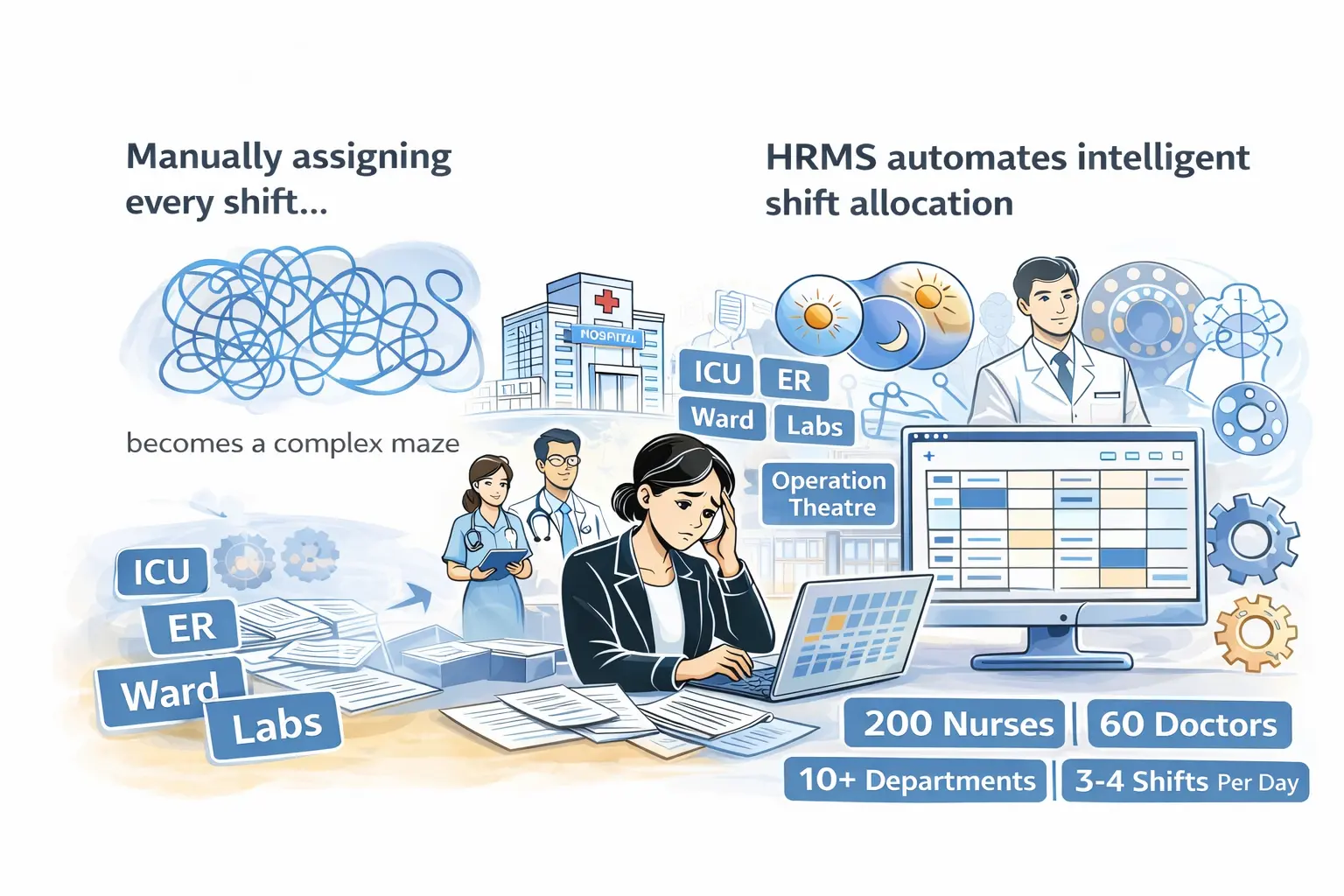
Patients arrive at all hours, emergencies happen without warning, and departments like ICU, ER, wards, labs, and operation theatres need the right mix of doctors, nurses, and technicians every hour of the day.
But managing hospital shifts is far from simple.
A medium-sized hospital might have:
200 nurses
60 doctors
40 technicians
10+ departments
3–4 shifts per day
Now imagine manually assigning every employee to every shift for an entire month.
Suddenly the problem becomes enormous.
Administrators must ensure:
Each department has enough staff
Only qualified employees are assigned
Labour laws are followed
Night shifts are fairly distributed
Leave requests are respected
If done manually, this often leads to mistakes.
Some shifts become understaffed. Some employees get too many night duties. Others remain underutilized.
This is exactly why hospitals are moving towards intelligent shift allocation in HRMS platforms.
But before we understand how intelligent allocation works, we first need to understand what shift allocation really means.
What is Shift Allocation?
At its simplest, shift allocation means deciding:
Who works where and when.
For example, a hospital may run three shifts:
Morning Shift: 7 AM – 3 PM
Evening Shift: 3 PM – 11 PM
Night Shift: 11 PM – 7 AM
Each shift must satisfy minimum staffing requirements.
For example:
Department | Doctors | Nurses | Technicians |
|---|---|---|---|
ICU | 1 | 3 | 1 |
Emergency | 2 | 5 | 1 |
Ward | 1 | 4 | 0 |
Lab | 0 | 0 | 2 |
Now multiply this across 365 days and hundreds of employees.
You quickly realize this is not a spreadsheet problem anymore.
It becomes an optimization problem.
The Core Idea: Workforce Optimization
An intelligent HRMS treats shift allocation as a constraint optimization problem.
The system tries to maximize staffing efficiency while satisfying multiple constraints.
Typical constraints include:
Hard Constraints (Must be satisfied)
Minimum staff required per department
Skill qualification
Maximum working hours per week
Minimum rest between shifts
Approved leave requests
Soft Constraints (Preferable)
Fair night shift distribution
Weekend rotation fairness
Employee shift preferences
Overtime minimization
The goal of the system is:
Find the best schedule that satisfies all hard constraints while optimizing soft constraints.
A Simple Example
Imagine a hospital ICU requires:
3 nurses per shift
And we have 5 nurses:
Nurse | Skill | Max Hours/Week |
|---|---|---|
N1 | ICU | 40 |
N2 | ICU | 40 |
N3 | ICU | 40 |
N4 | ICU | 40 |
N5 | ICU | 40 |
For one day with 3 shifts, total nurse requirement:
3 nurses × 3 shifts = 9 assignments
The HRMS algorithm must distribute these assignments without:
Exceeding weekly limits
Assigning consecutive night shifts
Ignoring leave requests
A valid schedule may look like:
Shift | Nurses |
|---|---|
Morning | N1, N2, N3 |
Evening | N2, N4, N5 |
Night | N1, N3, N5 |
Over the week, the algorithm balances workloads.
Technical Logic Behind Intelligent Allocation
Most modern HRMS systems implement shift scheduling using one of these techniques.
1. Rule-Based Scheduling
This is the simplest approach.
Administrators define rules such as:
Max 5 shifts per week
No more than 2 night shifts consecutively
Minimum 12 hours rest
The scheduler iterates through employees and assigns shifts based on rule satisfaction.
Pseudo-logic:
for each shift:
    find employees available
    filter by skill match
    filter by working hours limit
    assign employees with least workload
This works well for smaller hospitals.
2. Constraint Satisfaction Algorithms
Larger hospitals require more advanced approaches.
The scheduling problem is modeled as a Constraint Satisfaction Problem (CSP).
Variables:
Employee × Shift × DayConstraints:
Skill(employee) >= SkillRequired(shift)
Hours(employee) <= MaxWeeklyHours
Rest(employee) >= MinimumRest
The solver searches for combinations that satisfy all constraints.
Libraries commonly used:
Google OR-Tools
OptaPlanner
Choco Solver
3. Optimization with Scoring
Advanced systems assign scores to schedules.
Example scoring function:
Score =
   - (10 × overtime hours)
   - (5 × consecutive night shifts)
   - (3 × weekend imbalance)
   + (2 × employee preference satisfaction)
The system generates many schedules and chooses the one with the best score.
This approach balances fairness and efficiency.
Example: Real Scheduling Logic
Suppose a hospital has:
30 nurses
10 ICU-trained nurses
3 shifts
7 days
Total assignments needed:
ICU nurses needed:
3 per shift × 3 shifts × 7 days
= 63 ICU assignments
Algorithm steps:
Assign ICU shifts first (highest skill requirement)
Assign ER nurses next
Fill ward nurses
Balance workload across employees
Validate rest period rules
System Architecture in HRMS
A typical intelligent scheduling module includes:
1. Data Layer
Stores:
Employee profiles
Skills and certifications
Availability
Leave records
Labour law rules
2. Scheduling Engine
Runs the optimization logic.
Input:
staff
skills
shift requirements
constraints
Output:
weekly schedule3. Conflict Resolver
Detects issues like:
understaffed shifts
overtime violations
skill mismatches
4. Admin Dashboard
HR managers can:
manually override shifts
simulate schedules
approve final roster
Real Benefits for Hospitals
At first glance, this may seem like a technical scheduling improvement.
But the real impact is significant.
Hospitals using intelligent shift allocation can:
Reduce scheduling time
From:
8 hours manual planningTo:
10–15 minutes automated generationImprove staff satisfaction
Fair rotation prevents burnout.
Reduce overtime costs
Optimized schedules reduce unnecessary extra hours.
Ensure patient safety
Correct skill mix is always available.
Summary
Healthcare systems worldwide are under pressure.
Patient numbers are rising, staff shortages are common, and operational efficiency matters more than ever.
Intelligent shift allocation in HRMS platforms helps hospitals move from manual workforce planning to data-driven scheduling.
And when the right staff are in the right place at the right time, hospitals don't just run more efficiently. They deliver better patient care.