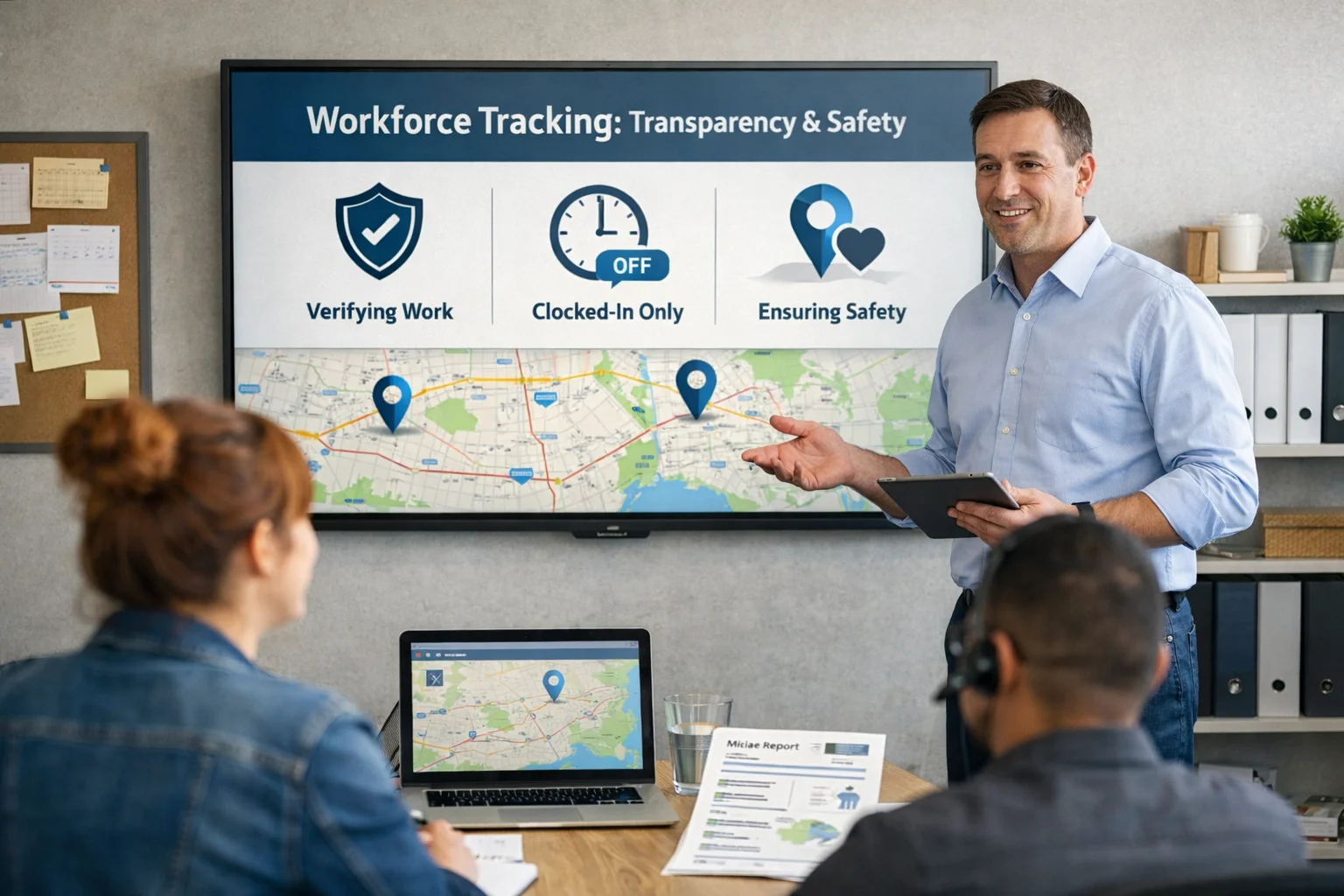
The biggest mistake we make when talking about employee tracking is framing it as a security or oversight issue. When HR tells a team that they are starting to track locations or activity, the collective heart rate of the office spikes. Employees immediately picture a digital eye hovering over their shoulder while they grab a coffee, and HR feels like the office villain tasked with enforcing a surveillance state.
It does not have to be this way. In fact, if done correctly, workforce tracking should actually remove pressure from HR, not add to it. The goal is to move from a culture of policing to a culture of proof. Here is how to strip the anxiety out of the process and turn tracking into a background utility that everyone actually appreciates.
Flip the Narrative from Watching to Verifying
The word tracking carries a lot of baggage. It sounds like something you do to a package, not a professional. To lower the temperature, HR needs to change the language. We are not tracking people; we are verifying their hard work.
Think about your field sales team or your site technicians. These people are out there grinding every day, often in high traffic or high stress environments. Without some form of digital record, their only way to prove their productivity is through manual logs, which everyone hates filling out.
When you implement an automated system, you are essentially giving them a receipt for their effort. It is no longer the job of HR to cross reference a spreadsheet against a fuel receipt. The system just confirms that the employee was at the client site at the scheduled time. That removes the friction of he said, she said and turns HR into a facilitator of accuracy rather than a skeptical auditor.
Draw a Hard Line at the Time Clock
Nothing kills employee trust faster than always tracking. If a staff member feels like the company is looking at their location while they are picking up their kids from school or at a doctor appointment, you have lost the battle. The most effective way to remove pressure is to make the technology consent heavy. Tracking should be a binary switch: when the employee is clocked in, the utility is active. The second they clock out, the eye closes completely.
HR should lead with this transparency. Show the team exactly what the dashboard looks like. Show them that the map goes dark the moment they finish their shift. When people realize the data collection is strictly tied to their professional output and does not bleed into their personal lives, the Big Brother anxiety usually evaporates within a week.
Use Data to Kill the Manual Tax
Manual processes are the silent killers of HR morale. If your HR team is spending three days a month chasing down mileage logs, calculating fuel reimbursements, or arguing over whether a technician actually made it to a remote site, they are not doing HR; they are doing data entry and dispute resolution.
Automated tracking removes this manual tax. By using verified distance calculations, the system can automatically generate a reimbursement report that is 100 percent accurate.
For the employee, there is no more keeping track of odometer readings. For HR, there is no more auditing rounded up numbers or squinting at crumpled gas station receipts. For the finance team, there is no more over paying by 10 or 15 percent due to estimated distances. When the system handles the math, the friction between HR and the workforce disappears.
Focus on Safety Not Just Seconds
If you want to get the team on board, talk about their safety. For field workers, being on the map is a safety feature. If a lone worker is at a remote site and does not check in, or if a driver is involved in an accident, having real time visibility is a literal lifesaver. HR can frame tracking as a support system. If a dispatcher or a manager can see that a team member has been stationary on a highway for an hour, they can proactively reach out to see if they need a tow or medical assistance. Moving the conversation from I am checking if you are working to I am making sure you are okay changes the entire emotional weight of the technology.
Kill the Stationary Anxiety
A common fear among office based or hybrid teams is that if they are not moving their mouse or standing at a specific coordinate, they will be flagged as lazy. This is where HR needs to step in and set clear expectations for managers.
Tracking should measure outcomes, not just activity. Use the data to spot trends, like identifying which routes are consistently blocked by traffic or which client sites take twice as long as expected. Use it as a tool for optimization, not as a stopwatch to measure bathroom breaks.
When HR uses data to make the lives of employees easier, such as optimizing routes so they get home 30 minutes earlier, the workforce stops seeing the tool as a burden and starts seeing it as a perk.
The pressure of workforce tracking only exists when there is a lack of transparency. If HR is clear about what is being tracked, when it is being tracked, and why it is being tracked, the resistance fades. In the end, the best tracking system is the one that stays in the background, making everyone’s job easier without ever needing to be discussed.