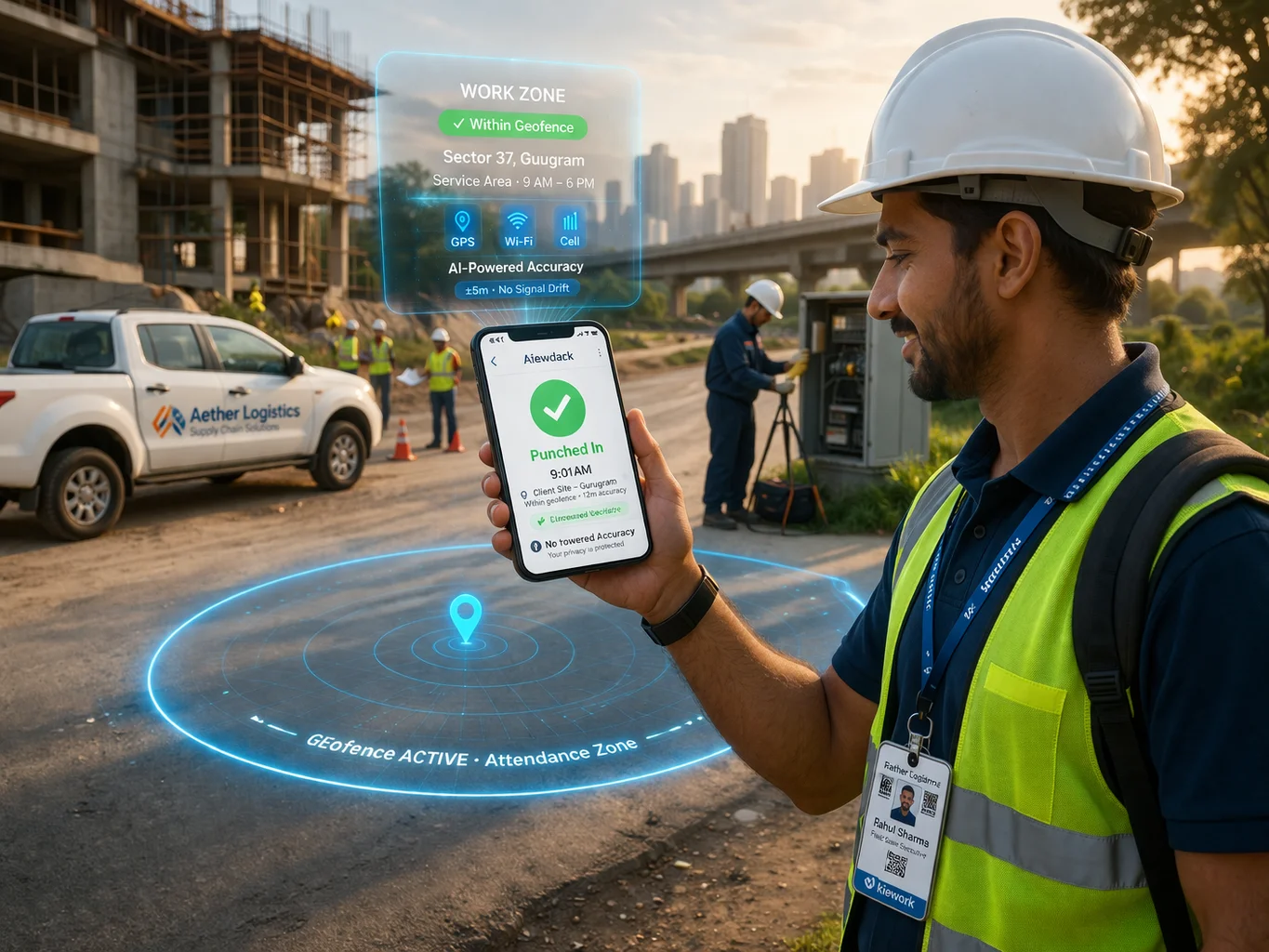
For organizations managing a remote or decentralized workforce, the traditional "punch-in, punch-out" model at a central office is obsolete. Field sales teams, logistics personnel, and service engineers are the lifeblood of many industries, but their mobility presents a distinct HR challenge: verifying physical presence without resorting to surveillance. This is the core conflict: the business need for operational accountability versus the employee need for privacy. Geofencing, creating invisible GPS-locked boundaries, is the solution, but when implemented poorly, it can become an intrusive "Big Brother" tracking mechanism that destroys trust.
The challenge is to create an effective, non-intrusive geofenced attendance system. This requires going beyond basic GPS tracking and adopting a smarter, privacy-focused approach that uses improved HRMS technology.
The Trust Gap in Traditional Geofencing
Standard geofencing implementations often suffer from two major problems. The first is inaccuracy. GPS signals in dense urban areas, affected by tall buildings or "signal drift," can incorrectly register an employee as being outside a work zone. This leads to "false rejections," where employees attempting a valid clock-in are denied, causing frustration, payment delays, and administrative chaos.
The second, more significant issue is privacy.Many basic tracking systems continuously collect an employee’s location data, essentially tracking their movements throughout the workday, even during lunch breaks or after hours. This level of monitoring can feel intrusive and, at times, come across as a lack of trust, which can impact employee morale and engagement. It also raises important legal and compliance considerations, especially around data privacy regulations like GDPR or India’s DPDP.
The AI Advantage: Precision and Privacy Combined
An advanced, AI-driven HRMS, like Kiework, bridges this gap by introducing intelligence and privacy-centric design. AI solves the trust equation by replacing constant surveillance with smart, event-driven validation. The key is a shift from "always-on" tracking to an "event-triggered" model. In this approach, the system only requests location data during the specific, essential moments of the Punch-In and Punch-Out workflow. When an employee clocks in, the AI-powered app simply checks their location once to confirm they are within the approved area. After that, it steps back. The rest of their day, including lunch breaks, travel between stops, and personal time after work, stays completely private. The system does not track or monitor where they are beyond that moment, because it is only focused on verifying attendance, nothing more.
Beyond GPS: Solving for Accuracy with Data Fusion
AI also addresses the operational issue of inaccurate GPS data. Instead of relying solely on the device's native GPS (which is easily compromised by urban noise or intentional spoofing via "fake location" apps), an intelligent HRMS utilizes "Fused Location Providers."
This approach leverages AI algorithms to combine data from multiple sources, including:
GPS Signals: Providing the primary coordinate data.
Wi-Fi Triangulation: Determining location based on known Wi-Fi network positions, essential for indoor and high-density urban settings.
Cell Tower Data: Offering broader, more resilient location intelligence when other signals are weak.
By intelligently fusing and filtering these data streams, the AI can filter out "signal drift" and accurately verify if an employee is truly inside the geofence. This prevents false rejections, ensures a seamless user experience, and builds trust that the system is fair and reliable. Furthermore, AI can identify and block "fake location" attempts, ensuring data integrity.
Total Accountability with Device Fingerprinting
A robust solution must also combat fraud, specifically "proxy punching," when an employee clocks in for a colleague. An AI HRMS ensures that the device itself acts as a unique biometric identifier through "device fingerprinting." This technique links a user's account to a specific physical handset, making it impossible to share credentials. This ensures total accountability, validating that the correct person is on-site.
The right AI-powered HRMS proves that geofencing and non-intrusiveness are not mutually exclusive concepts. Organizations can gain the precise, audit-ready data they need for field operations while simultaneously demonstrating a deep respect for employee privacy.
By moving away from constant monitoring to simple, event-based checks, and using smarter technologies like data fusion and device fingerprinting for accuracy and security, companies can create a more trust-driven work environment. Employees get the freedom to work flexibly, while businesses still have the accountability they need to perform well, without unnecessary tracking. The future of field operations may be geofenced, but with AI, it can also be built on respect, trust, and a genuinely human approach.